
Collaborative Innovation Models
Collaborative Innovation Models
Choosing Between Collaborative Projects, Consortia and Innovation Networks
Executive Summary
The Central Innovation Program for SMEs (ZIM) offers two fundamentally different approaches to collaborative innovation.
- Collaborative R&D projects enable companies to develop innovative technologies together with selected industrial and scientific partners in a focused and efficient way.
- ZIM Innovation Networks, by contrast, establish a long-term innovation ecosystem designed to generate multiple collaborative projects over several years.
Both instruments support innovation—but they serve different strategic objectives. Choosing the right collaboration model is often more important than choosing the funding program itself.
Key Insights
At a Glance
| Spotlight: | ZIM Innovation Network / ZIM-IN |
|---|---|
| Funding Authority | Federal Ministry for Economic Affairs and Climate Action (BMWK) |
| Minimum SME Partners | 6 (4 for international networks) |
| Additional Partners | Universities, research institutes, customers, suppliers, large companies |
| Network Management | Publicly funded for up to three years |
| Network Objective | Generate continuous collaborative R&D projects |
Two Collaboration Models – One Strategic Objective
Innovation rarely happens in isolation. Within ZIM, companies can choose between two complementary approaches to collaborative innovation. The first is the collaborative R&D project: a focused consortium of selected partners working together to solve a clearly defined technological challenge.
The second is the Innovation Network: a professionally managed ecosystem designed to continuously generate collaborative projects around a shared technology vision. Both models create value—but they address different stages of innovation maturity.
Choosing the Right Collaboration Model
| Collaborative Projects | Innovation Networks |
|---|---|
| Rapid project initiation | Longer preparation phase |
| Low organizational overhead | Professional network management |
| Clearly defined technology challenge | Long-term technology roadmap |
| Stable project consortium | Continuously evolving ecosystem |
| Ideal for focused R&D. Faster route to commercialization | Ideal for continuous innovation pipelines. Long-term ecosystem development |
Why We Often Recommend Collaborative Projects
Innovation Networks are powerful—but they are not always the most effective starting point. For many SMEs, collaborative ZIM projects provide a significantly faster and leaner path toward successful innovation. A consortium can be established within a short period, project responsibilities are clearly defined and the administrative effort remains manageable.
Most importantly, companies immediately begin developing technology instead of first building organizational structures. Collaborative projects also provide an excellent opportunity to validate new partnerships before expanding into larger strategic ecosystems.
When Innovation Networks Create Exceptional Value
Innovation Networks become particularly attractive when innovation itself becomes continuous rather than project-based. Typical situations include:
- Emerging industrial platforms
- Cross-disciplinary technology fields
- Long-term technology roadmaps
- Multiple planned collaborative projects
- Large partner landscapes involving industry and research
- Regional or international innovation ecosystems
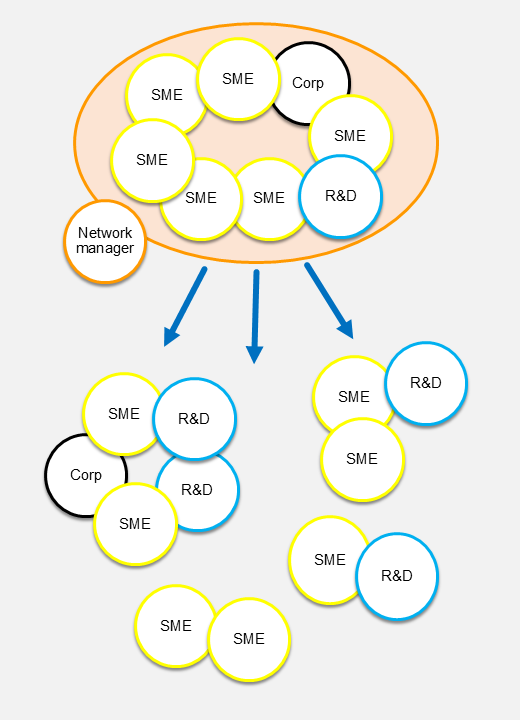
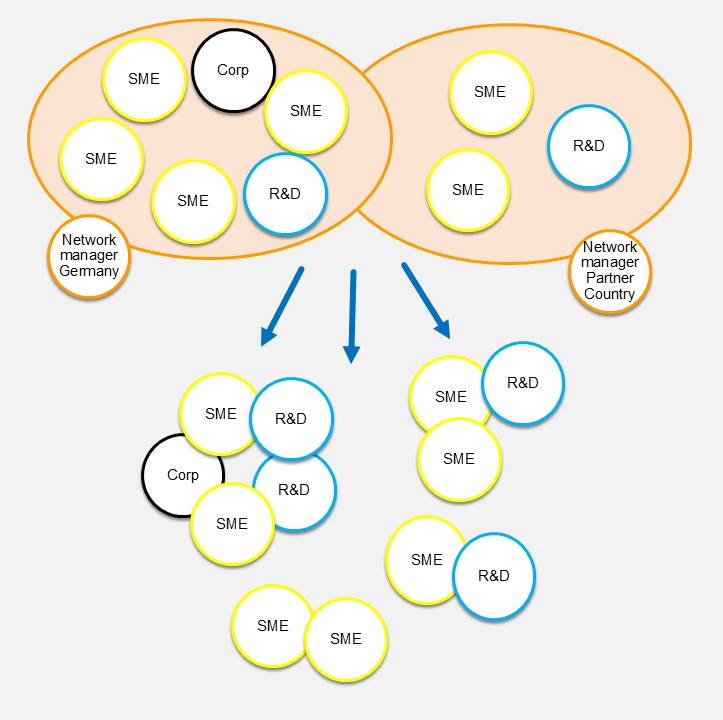
In these environments, the network itself becomes a strategic asset that continuously generates new innovation opportunities. Two types of Innovation Networks are possible:
- National ZIM-INs, left
- International ZIM-INs, right
The Role of Professional Network Management
Successful innovation ecosystems require active leadership. Network management is responsible for:
The objective is not administrative coordination—it is the continuous creation of innovation opportunities.
Critical Success Factors
- A Shared Technology Vision: Every successful innovation ecosystem begins with a clearly defined strategic technology field.
- Complementary Expertise: Customers, suppliers, SMEs and research institutions each contribute capabilities that no single organization possesses.
- Professional Orchestration: Networks require continuous moderation, partner development and strategic coordination.
- Continuous Project Generation: The objective is never one successful project. The objective is a continuous innovation pipeline.
- Trust: Open collaboration and long-term commitment are the foundation of every successful innovation ecosystem.
Collaborative Project
Innovation Network
Continue Exploring
Deepen your understanding of innovation funding, collaborative R&D and strategic innovation networks for German SMEs.
Let’s Start a Conversation
Considering ZIM for your next innovation project? Whether you are evaluating a new technology, planning your innovation pipeline or exploring collaborative development, we’d be delighted to discuss your plans. All conversations will be treated with the utmost discretion. It is complimentary and without obligation. → Schedule a Strategic Conversation